CRO
Shopify Store Redesign: 7 High-ROI Fixes to Make Before Scaling Ads
Scaling ads on a broken store is like pouring water into a leaky bucket. Use this Shopify store redesign checklist to fix your conversion rate and maximize ROAS first.
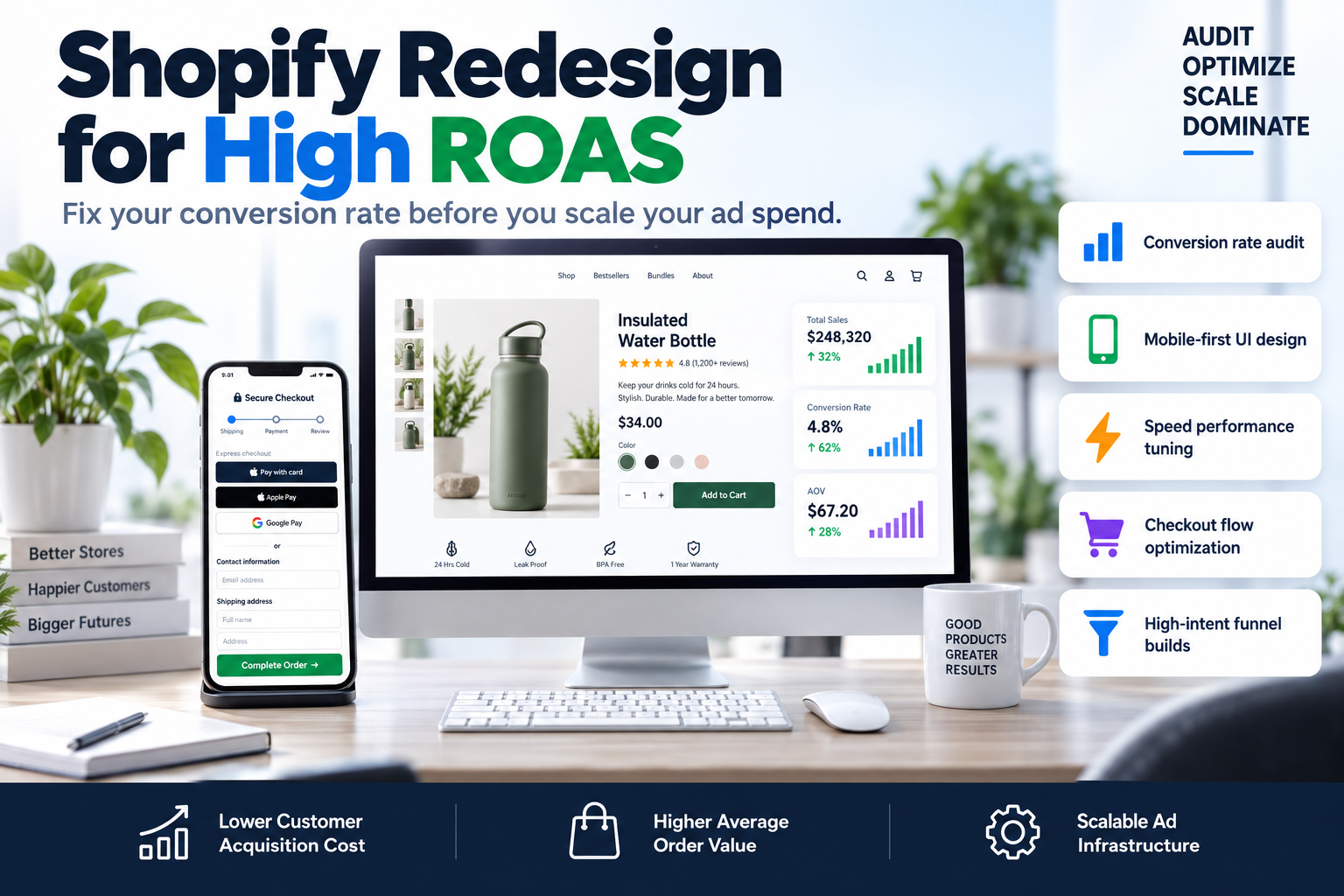
Most ecommerce founders make a fatal mistake: they try to solve a revenue problem by throwing more money at Meta and Google. But if your traffic is landing on a cluttered, slow, or confusing site, you aren't scaling—you're subsidizing the ad platforms. A comprehensive Shopify store redesign isn't just about a fresh coat of paint; it is about plugging the leaks in your sales funnel so that every dollar of ad spend works three times harder. Before you increase your daily budget, you must ensure your infrastructure can actually convert high-intent traffic into paying customers.
At SkyByte, we see dozens of brands burning cash because their "storefront" is actually a barrier to entry. This guide outlines the mission-critical elements you must address during your redesign to ensure your brand is ready for aggressive growth.
Why a Shopify Store Redesign is Your Best Ad Strategy
Advertising costs are at an all-time high. The brands that win in 2024 and 2025 aren't the ones with the best ad creative; they are the ones with the highest conversion rates. If your current conversion rate is 1.5% and you can bump it to 3% through a strategic Shopify store redesign, you have effectively cut your customer acquisition cost (CAC) in half without changing a single thing in your Facebook Ad Manager.
Optimization must happen at the foundation. A redesign allows you to re-evaluate your user journey, remove friction points, and implement modern CRO (Conversion Rate Optimization) frameworks that standard templates often ignore.
1. Mobile-First Architecture (Not Just Responsive)
Most Shopify themes are "responsive," meaning they shrink to fit a mobile screen. That is the bare minimum. A high-converting Shopify store redesign focuses on mobile-first architecture. This means:
- Thumb-zone navigation: Placing critical buttons (Add to Cart, Checkout) where they are easy to reach.
- Sticky CTA buttons: Ensuring the 'Buy' button is always visible as the user scrolls through long product descriptions.
- Reduced visual clutter: Stripping away heavy sidebars and desktop-only hover effects that slow down mobile users.
2. Page Speed and Core Web Vitals
Google and shoppers alike have zero patience for slow sites. Every second of load time can result in a 7% drop in conversions. During your Shopify store redesign, you must prioritize technical performance.
| Metric | Goal | Action Item |
|---|---|---|
| LCP (Largest Contentful Paint) | < 2.5s | Optimize hero images and use WebP formats. |
| CLS (Cumulative Layout Shift) | < 0.1 | Set explicit dimensions for images and containers. |
| TTFB (Time to First Byte) | < 500ms | Minimize excessive Shopify apps and heavy scripts. |
3. High-Converting Product Page Structure
Your product page is your most important landing page. If you are sending ad traffic here, it needs to follow a psychological hierarchy of information:
- The Hook: High-quality imagery and a clear, benefit-driven headline.
- The Proof: Star ratings and "X people viewing this" social proof triggers.
- The Solution: Bulleted lists of benefits (not just features).
- The Reassurance: Trust badges, shipping info, and return policies right under the CTA.
- The Context: User-generated content (UGC) and video reviews.
4. Frictionless Checkout Experience
Cart abandonment is the silent killer of ROAS. A Shopify store redesign should simplify the path from "Add to Cart" to "Thank You." Implement a slide-out cart (mini-cart) so users don't leave the product page, and ensure you have one-click payment options like Shop Pay, Apple Pay, and Google Pay enabled. The fewer fields a customer has to fill out, the higher your revenue will be.
5. Strategic Cross-Sells and Upsells
Increasing your Average Order Value (AOV) is the fastest way to make expensive ads profitable. Don't just hope people buy more; design it into the UI. Use "Frequently Bought Together" modules and post-purchase one-click upsells. This turns a single-product buyer into a high-value customer instantly.
6. Trust and Authority Signals
A redesign gives you the chance to fix "sketchy" design elements. Professional typography, consistent branding, and a clear "About Us" story build the trust necessary for a stranger to hand over their credit card info. If your site looks like a drop-shipping template, your conversion rate will reflect that.
7. The SkyByte 'Profit First' Redesign Framework
When we handle a Shopify store redesign, we follow a specific 5-step framework to ensure the new site isn't just pretty, but profitable:
- Data Audit: We analyze your Google Analytics and Heatmaps to see where people are currently dropping off.
- Funnel Mapping: We define the "Golden Path" from landing to checkout.
- UI/UX Prototyping: We design high-fidelity mockups focusing on mobile conversion.
- Technical Implementation: We build on a clean, fast Shopify 2.0 theme architecture.
- Post-Launch Optimization: We A/B test key elements to squeeze every drop of ROI out of your traffic.
Frequently Asked Questions
How long does a full Shopify store redesign take? Typically, a high-performance redesign takes 4 to 8 weeks depending on the complexity of your catalog and the custom functionality required. The goal is to move fast but ensure every pixel is optimized for sales.
Will a redesign affect my SEO rankings? If done correctly, it will improve them. By improving site speed, mobile-friendliness, and user engagement (Dwell Time), you send positive signals to Google. We ensure all 301 redirects are handled so you don't lose existing traffic.
Should I redesign my store or just build landing pages? If your entire catalog needs a lift, a store-wide Shopify store redesign is best. However, for specific ad campaigns, we often recommend building high-conversion sales funnels that bypass the main store to focus on a single offer.
Stop Wasting Your Ad Budget
Running ads to a sub-optimal store is a choice to lose money. If you are ready to scale, you need a partner who understands the intersection of design, psychology, and ecommerce technology. SkyByte specializes in turning underperforming websites into high-output sales machines using advanced CRO and GoHighLevel integrations where necessary to capture and nurture leads.
Don't wait until your ad account is in the red. Book a discovery call with SkyByte today to discuss your Shopify store redesign or get a free funnel audit to see exactly where your current site is losing money. Let's build a foundation that scales.