Web Design
How to Outsource Website Development and Maintain Total Control
Scaling your agency shouldn't mean losing your grip on quality. Discover the exact frameworks for outsourcing web development while maintaining 100% control.
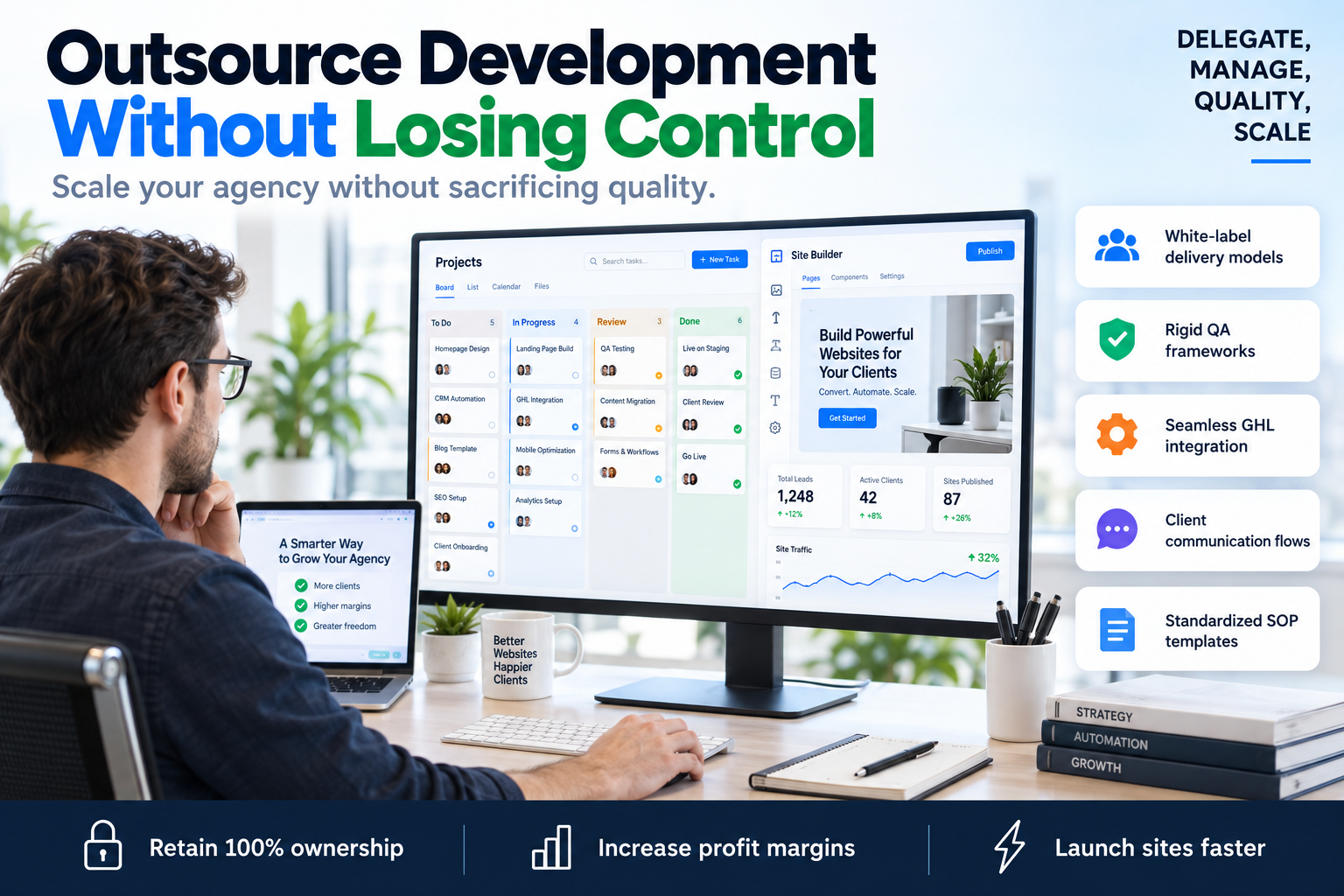
Most agency owners reach a breaking point where they must either stop growing or start delegating. However, the fear of a botched delivery keeps them trapped in the 'doer' role. If you want to scale, you must learn how to outsource website development without sacrificing the quality your clients expect or the control your brand requires. When you outsource, you aren't just buying code; you are buying capacity. The friction arises when communication breaks down and the 'black box' of development leads to missed deadlines and buggy launches.
At SkyByte, we’ve seen how improper delegation can ruin a reputation. But we’ve also perfected the systems that allow agencies to function as the strategic architect while third-party experts handle the heavy lifting. This guide breaks down the tactical framework for outsourcing development while keeping your hand firmly on the steering wheel.
The Risks of Blind Outsourcing
Before you hire a developer, you must identify the three primary risks that lead to project failure:
- The Communication Gap: The client tells you what they want; you tell the developer; the developer builds what they think you said. Each hop loses 20% of the intent.
- Technical Debt: Inexpensive developers often cut corners on site speed, mobile responsiveness, or SEO metadata—leaving you to fix the mess.
- Client Perception: If the client realizes you aren't the one doing the work, they may question your margins unless you position yourself as the Strategic Lead.
A Framework to Outsource Website Development Successfully
To maintain control, you need a system that treats the developer as an extension of your team rather than an external vendor. We call this the SkyByte Control Loop.
1. The Strategy-First Briefing
Never send a developer a message that says, "Build a site for a plumber." You must provide a high-fidelity brief that includes:
- User Personas: Who is the site for?
- Conversion Goals: Is it a lead magnet, a direct booking, or an e-commerce checkout?
- Tech Stack Requirements: Are you using GoHighLevel (GHL) for its automation capabilities, or a headless CMS?
- Sitemap and Wireframes: Low-fidelity sketches prevent high-fidelity mistakes.
2. The Sandbox Environment
Never give an outsourced developer access to your main client accounts or live environments immediately. Use a staging server or a sub-account within GHL. This allows you to audit the work before it ever touches the client’s domain. You maintain control over the 'Publish' button.
3. Standard Operating Procedures (SOPs)
Control is maintained through documentation. If you don't have a checklist for what a 'finished' site looks like, your developer will make up their own. Your SOP should include:
- Image optimization standards (WebP vs. JPEG).
- H1-H4 heading hierarchy for SEO.
- Mobile-first design verification.
- Integration of tracking scripts (FB Pixel, Google Tag Manager).
Comparing In-House vs. Outsourced vs. White-Label
| Feature | In-House Team | Freelance Outsourcing | White-Label Agency |
|---|---|---|---|
| Cost | High (Salaries + Benefits) | Low to Medium | Fixed per Project |
| Control | Absolute | Variable / Risky | High (SOP-driven) |
| Scalability | Slow | Fast | Instant |
| Quality | Consistent | Hit or Miss | High / Specialized |
How to Outsource Website Development Using GoHighLevel
For B2B brands and coaches, GoHighLevel (GHL) has revolutionized the ability to outsource website development. Because GHL uses a proprietary builder, you can create 'Snapshots.'
A Snapshot allows you to build a template with pre-configured funnels, workflows, and pipelines. When you outsource to a GHL expert, you aren't just getting a website; you are getting a functional sales engine. You can then lock certain parts of the account so the developer can build the UI without touching your proprietary automation logic. This is the ultimate way to maintain control over the intellectual property of your sales funnel while outsourcing the visual design.
The Three-Stage Quality Assurance (QA) Process
Control is lost during the QA phase if you haven't defined what 'done' looks like. Implement this three-stage check:
- The Developer Self-Check: The developer must sign off on your SOP checklist before submitting the work.
- The Internal Audit: Your project manager (or you) reviews the site against the original brief. Check every button, every link, and every form submission.
- The Stress Test: Check the site on BrowserStack to ensure it works on older iPhones, tablets, and various desktop resolutions.
Managing the Client Relationship
You should always remain the sole point of contact. This is often called 'White-Labeling.' The client pays for your vision, your strategy, and your brand's guarantee of quality. The fact that you outsource website development to a specialized execution team is a benefit—it means the client is getting a team of experts rather than a single generalist. Position your developers as your 'Back-end Execution Team' or 'Technical Specialists.'
FAQs About Outsourced Development
Q: How do I handle revisions without losing money?
A: Define the number of revision rounds in your contract with the developer and your contract with the client. Usually, two rounds of revisions are standard. Anything beyond that should be billed as a change order.
Q: Should I pay by the hour or by the project?
A: For website development, project-based pricing is superior. It aligns the developer's goals with yours (finishing the project) and prevents 'scope creep' from inflating your costs.
Q: What if the developer disappears?
A: This is why you must maintain ownership of the hosting, domain, and code repositories. Never let a developer buy the domain on their personal account. If you are using GHL, you own the sub-account; they are simply a 'User' you can delete at any time.
Scaling Your Agency with SkyByte
Outsourcing shouldn't be a gamble. It should be a calculated move to increase your agency's capacity and profit margins. By utilizing platforms like GoHighLevel and following rigid SOPs, you can deliver world-class websites without ever touching a line of code yourself.
If you are struggling to bridge the gap between high-level strategy and technical execution, we can help. Whether you need to fix your problem with a broken funnel or you want to book a discovery call with SkyByte today to discuss a full-scale white-label partnership, our team specializes in building the systems that allow you to lead while we build. Don't let technical hurdles stop your growth. Get a free funnel audit and see how we can optimize your conversion rates and automate your client delivery today.